[Hawach Scientific] Plastic Autosampler Vials
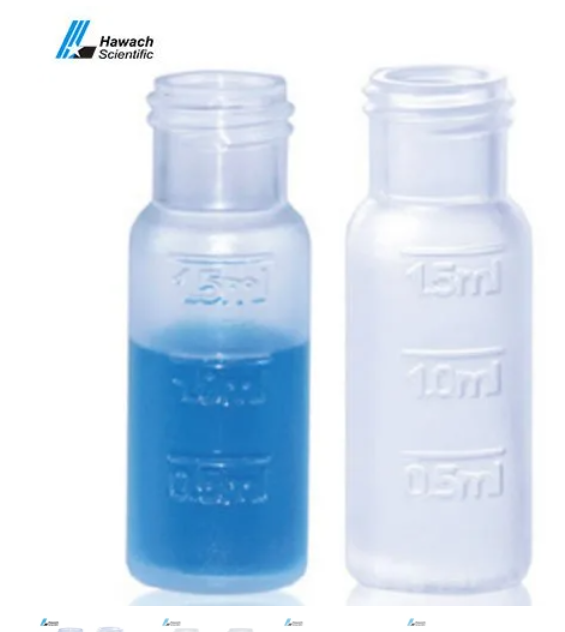
| Cat# | Description | Package |
| 20041001 | Sample Vials with Welded Insert Tubes,0.3mL, 9-425, PP, Clear | 100pcs/Pack |
| 20041002 | Sample Vials with Welded Insert Tubes,0.3mL, 9-425, PP, Amber | 100pcs/Pack |
| 20041003 | Sample Vials with Welded Flat Bottom Insert Tubes, 0.7mL, 9-425, PP, Clear | 100pcs/Pack |
| 20041004 | PP Sample Vials with Graduation, 9-425 | 100pcs/Pack |
| 20041005 | Caps for 9-425 Sample Vials, Blue Smooth Cap, with 1.0 mm White Rubber/Red PTFE Septa, No Pre-slit | 100pcs/Pack |
| 20041006 | Caps for 9-425 Sample Vials, Blue Ribbed Cap, with 1.0 mm White Rubber/Red PTFE Septa, Pre-slit | 100pcs/Pack |
Plastic autosampler vials, also known as plastic sample vials or plastic sample containers, are used in laboratories for the storage and analysis of liquid samples. These vials are made from polypropylene (PP).
Advantages
- Lightweight: Plastic vials are generally lighter than glass vials, which makes them easier to handle and transport.
- Durability: Plastic vials are less prone to breakage compared to glass vials, making them suitable for rugged environments or situations where there is a higher risk of accidental damage.
- Chemical resistance: Plastic vials can be made from materials that exhibit excellent chemical resistance, ensuring sample integrity and minimizing the risk of contamination.
- Cost-effective: Plastic vials are often more affordable than glass vials, making them a cost-effective choice, especially for large-scale sample analyses.
- When selecting plastic autosampler vials, it’s essential to consider the specific requirements of your application, including compatibility with the sample type and analysis method.
Plastic autosampler vials are commonly used in analytical laboratories for the storage and analysis of liquid samples. These vials are typically made of high-quality polypropylene (PP). Here are some features and applications of plastic autosampler vials:
Features of Plastic Autosampler Vials
- Material Durability: Plastic autosampler vials are designed to be chemically resistant, ensuring the integrity of samples and preventing contamination or leaching of substances from the vial walls.
- Transparency: Most plastic vials are transparent, allowing for easy visual inspection of the sample inside. This is especially useful when monitoring color changes or the presence of particulates.
- Versatility: Plastic vials are available in various sizes, shapes, and capacities, making them suitable for different applications and accommodating different sample volumes.
- Closure Options: Plastic vials can be paired with different types of closures, such as screw caps or snap caps, providing secure sealing to prevent sample evaporation or contamination.
- Compatibility: Plastic autosampler vials are compatible with a wide range of automated liquid handling systems, including autosamplers, allowing for efficient and reliable sample preparation and analysis.
Applications
- Chromatography: Plastic autosampler vials are commonly used in gas chromatography (GC) and liquid chromatography (LC) techniques. They are suitable for storing and injecting liquid samples for analysis, such as HPLC (High-Performance Liquid Chromatography) or GC-MS (Gas Chromatography-Mass Spectrometry).
- Pharmaceutical Analysis: Plastic vials are widely used in pharmaceutical laboratories for sample storage and analysis. They can hold liquid samples of drugs, raw materials, or formulations, allowing for precise and reproducible measurements.
- Environmental Analysis: Plastic vials are used for sample collection and preservation in environmental monitoring and testing. They can store water, soil, or air samples for analysis of contaminants, pollutants, or environmental parameters.
- Clinical and Biological Research: Plastic autosampler vials are utilized in clinical and biological research laboratories for the storage and analysis of biological samples, such as serum, plasma, urine, or DNA/RNA samples.
- Food and Beverage Analysis: Plastic vials find applications in the food and beverage industry for sample storage and analysis. They can hold liquid samples of juices, wines, oils, or food extracts, enabling quality control and analysis for safety and authenticity.
It is important to note that plastic autosampler vials may have limitations compared to glass vials, such as lower resistance to certain solvents or higher levels of adsorption. Therefore, the choice of vial material should be based on the specific requirements of the analysis and compatibility with the sample and analytical methods.
'Hawach Scientific' 카테고리의 다른 글
| [Hawach Scientific] Plastic Test Tubes (0) | 2025.09.08 |
|---|---|
| [Hawach Scientific] Gray Top Glucose Tube (0) | 2025.09.05 |
| [Hawach Scientific] Qualitative Filter Paper Grade: BIO-4 (1) | 2025.07.07 |
| [Hawach Scientific] 5 mL Centrifuge Tubes (0) | 2025.06.16 |
| [Hawach Scientific] Diol Flash Column (2) | 2025.06.12 |


